

The Kraken1 has been busy, and the hype is real. AI – short for Artificial Intelligence – is on everybody’s mind. Proponents, meaning big tech and their trusty minions, are pushing this aggressively onto everybody’s agenda as if the end of the world is nigh. You know, to prevent us from catching our breath and suddenly using our remaining neurons to parse this correctly before blindly driving into a wall and just becoming mindless acolytes right away. A mainly American and ideologically-challenged narrative driven by a handful of tech bros so disconnected from reality that it boggles the mind. Or, should we say that they actually create their very own new reality? One where ad revenue reigns supreme, and nothing else matters, lies and all? Perhaps.
Boy, it even got to the point where RMR himself had to establish some rulez governing the acceptable use of such tools on this specific webzine. And it is all about installing some checks and balances into the (perceived) US information tech supremacy that the docile US allies have let run unchecked since World War II. A policy that I fear will fail spectacularly in the not-so-distant future. But I digress.
Because today we want to talk about Google and their unholy urge to maximise the flow of ad monies through AI-powered searches, come hell or high water. And about what that might will do to webzines such as RMR in the mid to long run.
The Good ol’ Times
I don’t know if you’re old enough to remember, but there was a time when the internet was a fun and – at the same time – a scary place. You went ahead, asked what you wanted to see, and got served with a slew of links to choose from. Simple, effective, and a completely new and exciting universe consisting of ones and zeros that should facilitate communication and access to knowledge. Not that all was cool and dandy with this new technology. The space was largely unregulated and, apart from useful uses, immediately attracted a gazillion misfits of all kinds. A carefree environment to exploit their often sickening endeavors.
The windows leading into this space were the early browsers. Tech aficionados may remember the Mosaic browser that saw the light of day in 1993. Microsoft usurped this technology2 to create the Internet Explorer 1.0 browser version in 1995. A tool that – whilst fraught with a ton of technical issues – was nonetheless successful. Be it for the simple fact that it was mass-distributed with the – at that time – revolutionary Windows 95 operating system. A system that you owned outright and were free to do what the hell you wanted with it. Quite the contrary to modern times.
I still remember how much the early IE versions sucked. And we all tried to escape Microsoft’s steely claws by changing to Netscape, yet another tool based on the aforementioned Mosaic technology. A now-defunct, neatly constructed tool that served us all well over the early years until AOL killed it in the early ’00s. Some of its technology allegedly still lives on in today’s Firefox browser. But that will be fodder for another article. Some time in a distant future.
Oh, and if you wonder why we never mention Apple’s Safari browser, it is because it won’t signify. Apple always navigated in their very own, closed bubble and didn’t concern itself much with those strange cryptids populating IT’s very own Wild West.
So, where has Google been in all that?
Well, nowhere for a considerable length of time. Let’s remember that Google was incorporated only in 1998. So, at a time when Microsoft and Netscape were slugging it out already for a while.
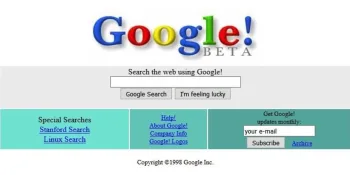
The company started with an early version of Google Search, which – surprisingly – came with a clean-looking, almost bare-bones search screen. A design that hasn’t changed all that much ever since. Apart from a few details that I’m sure much consultancy work was spent on.
The presentation of Google’s browser was a revelation. You were greeted with a slick, empty, frugal, white start page with a search box. No unnecessary features, just a page delivering a series of links from which you could choose to deepen your research. None of IE’s clunkiness was evident on the company’s new search interface. And it even beat the comparatively nifty Netscape tool into the dust.
Google Chrome 1.0 was released only in December 2008. The engine was based on the open-source tech of other browsers that already existed.3 Meaning, the company didn’t really invent anything. Instead, they stole data from other sources and used it to develop their own. Sounds familiar? It does, because stealing everyone’s data is and has been one of their main features forever. But more to that later.
The March to Google Supremacy
Now, fast-forward to present times. There is no desire to tell Google’s story over here. Things have changed dramatically over the last roughly 30 years or so. And in the year 2026, the Google search engine has torn a lot of its usefulness to shreds and become Google’s very own Frankenstein’s wife or something.
Let me explain.
Since its inception, The Kraken’s search tool has gone through many iterations. It morphed from a relatively simple, link-based tool that was easily manipulable for website owners trying to get to the famed Page One of Google Search to a complex behemoth of a tool. And at first, the application delivered results that were actually useful for a while. But then, the algorithm behind the search became ever more complex and commercially driven. Or at least that is what we think, because the existence of the famed Page Rank4 was never really acknowledged. And it was – for sure – never made publicly available.
For the record, Page Rank was discontinued in 2016, and the patents expired by 2019. There’s currently another, even cloudier algorithm in service that feeds even more off its typical smokes and mirrors than its predecessor ever did. But to obtain clarity about the inner workings of whatever tool Google may use, you can wait until hell freezes over. They fear that thought like the devil the overhyped holy water. I reckon there’s a whole bunch of sins to hide in that juicy set of software, such as backdoors so that the NSA and other bad actors can freely roam your data.5 Stuff we hear around the interweb, y’know.
Apart from stealing your privacy without much of your consent through a gazillion trackers, Google refined the art of maximising profits on the ad revenue stream. True, if you operate a website, you can latch on to tools like AdSense to generate a slice of the revenue stream for you. If you are willing to let the tool pollute your site in many unspeakable ways, that is. And what website owners might perceive as a gilded windfall will give Google the green light to place ads directly on websites they would not have access to otherwise. And besides, most of the monies flow directly to Google, and it is difficult to generate a decent return on your site’s toxic ad contamination alone.
Google Today – The Bane of the User
At this moment, you are faced with a sophisticated drama queen of a search engine that is as anally cinched to political correctness as it is hellbent on ensuring that your data freely flows back into their coffers for little or no return to you, the user. And all of that is done to feed the greedy and all-important advertising revenue behemoth.
It is almost comical how a friggin’ search engine tries to guide you as if you were a toddler. And it is – yet again – mostly American values that are pushed on you at any given time. And make no mistake, Google haven’t discovered the goodness at the bottom of their hearts. It is and will always be a consideration linked to shareholder value. Meaning, the company tries to keep the ad money flowing by catering to their clients’ beliefs. You, the user, are actually the product being sold to whatever data broker might take an interest. Apart from the Kraken’s own products that you might contract directly, such as YouTube.
Marketshare and Competition
At the time of writing this article, the Google Search Engine’s market share hovers around 90% at any given time. Meaning, in today’s day and age, you cannot avoid their steely claws. In comparison, Microsoft’s Bing search sneaks in at a measly 5% or so. And the rest of them all sit at the kiddie’s table to share the leftovers. Oh, and what about European providers? I’m glad you asked. There are some, such as Ecosia or a thing called Swisscows, believe it or not. But none of them has the size and heft to break the current supremacy the Google tool wields like the Sword of Damocles over everybody’s heads.
Now, this madhouse dance of showing you a never-ending slew of sponsored links before you even get to any semblance of an intelligent search result has become the status quo compared to the past. A time when, after some insane clicking through unwanted results, you actually got some meat to the bone.
The users or pawns in that game of chess find themselves in a situation where trying to escape the trackers and the manic ad machine has become an almost impossible task. One can – of course – pay the piper by handing out some dough for the use of some of Google’s tools. But that practice won’t work with the browser. There is – to our knowledge – no paid Google tool that would allow anyone to curtail the relentless flow of anything sponsored. So, in essence, the mean user is between a rock and a hard place when it comes to internet searches.
Because with the arrival of artificial intelligence, things just took a turn for the worse.
SEO and AI, the Unholy Spirit of the Interweb
The SEO Conspiracy
For many years, the Google whisperers of the SEO business, short for Search Engine Optimization, tried to help webzine owners catch up to speed and have at least a fighting chance to get near the famed top of Page One. Whatever this may mean. Yet a lot of these efforts were fueled by a business caught in between John Mueller’s6 cryptic messages and some SEO Black Magic voodoo kind of thing.
A task made even more difficult by the fact that Google here will suddenly invent new rules with little or no notice, and try to be as unclear as possible to the point of invoking the dark shadows of ulterior motives. Back in the early ’20s, they started to move towards mobile data only, inventing new measuring sticks nobody ever heard of. KPIs7 such as FID, FCP, LCP, CLS, TTFB, all need to be followed to avoid your digital ass sinking to the bottom where the wrecks of other sites dwell in obscure stillness. Cut off from the drip, drip of clicks and revenue by some bizarre algorithm without a soul or practical understanding. Google has always been very callous to those actually creating content. To the point that their practices lose us time, and we hate nothing more than that. And it will be getting worse.
Sure, you can try to parse extensive documentation that is often streamlined for complicated reading. And no, most of us don’t have time to read endless click generators that say almost nothing with a ton of links to more material. Talk about abuse of power at a relatively grand scale.
Now, this isn’t to belittle the valiant efforts of the SEOs such as Yoast, who deliver real value to webzine owners and help them spiff their websites’ inner workings to a point, so that bots can actually understand what they can find. In fact, they deserve your respect, as many of Google’s arbitrary rules are built into the tools they offer. Of course, those companies will try to sell you a load of unnecessary junk as well, and they will cost you a mint. But as a webzine owner, the base product at the heart of it is money well spent.
The Rise of AI
Enter Artificial Intelligence, a new service loosely crawed by the tech bros’ peddlers as being the next economy-transforming nirvana thing. Mostly all American yet again, a number of providers offer models such as Open AIs Chat GPT8 as part of their large language models (LLMs in shortcode). And as always, the old tech bro rule to move fast and break things applies here as well. To the point that the end will inevitably result in today’s AI search results going way off into la-la land.
Rumor has it that about 90% of replies AI produces are correct, which should really worry Google Org, the flailing tech giant. Even if the real number of fails must be much higher, given that the result comes straight from the proverbial horse. Gemini reported that Google Search processes about 16 billion queries every single day. And the AI is included in about 50% of all those queries. Meaning, they generate a so-called AI Overview that bores its way by brute force onto the Numba One Page on Google Search, want it or not. So, the remaining 10% of potentially incorrect answers still means that the AI freely hallucinates on a phenomenal amount of queries. Or put more succinctly, the robot lies worse than Donald Trump.
The Dead Internet Theory Reloaded
So, what changed compared to the former way of handling search results? A lot. As a user, you now get an AI Overview shoved in your face that you never asked for, and the robot even encourages you to communicate with it through the communication box. On mobile, the summary is – nota bene – kinda difficult to remove through a mechanism specifically installed by Google.
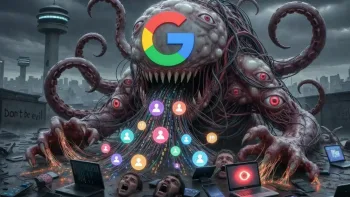
You get an often over-simplified wrap-up full of data stolen from content creators. With a scant shot taken at legitimacy through quoting at least some of the links pointing to where all that data came from. And this leads to a situation for site owners where Gemini freely taketh their hard work, mushies it up somewhat, and presents it as fact. Very few search users will actually click on links or move beyond the overview screen. And this means that clicks and revenue to sites will dwindle to nothing. At least for review sites such as RMR, which sell nothing but content gone intellectual property that those AI bots train their models on without any reward back to the sources they steal freely from.
A perverse side effect beneficial for Google is that with fewer clicks on sites, ad revenue will be concentrated on the Google brand. Taking the example of AdSense again, this means fewer clicks on ads on third-party sites, and thus less monies paid to their – partners.
In essence, all of the above means that Google AI, and by that token all other models, will start to eat their own. With the AI Overview pushed on users and many of them never leaving this particular bubble, many real content creators will just cease publishing. There is just not enough revenue to be had for most of them, unless all of us want to start selling t-shirts or porn. So, real content will diminish and be replaced by more AI slop and bad actors high on a rush of Trash SEO. Folks trying to game the system to sell whatever snake oil they currently have in their worm-infested minds.9
The Kraken risks – in turn – losing much of their cherished ad revenue. Because, you see, which business in their right mind will want to squander their hard-earned credibility on articles full of scams, grifts, and worse.10 Because, in time, there will be nothing worth a shred of decency left on the web. In other words, Google and their cronies may well have created that perfect storm, a situation where Moloch eats its own. Resulting in an internet that will disappear in a maelstrom of AI-generated atrocities, fake news, and scams.
Thus, the internet will finally be truly dead, replaced with a dystopian new world, where the toothy clowns run the circus. Let’s just hope that guardrails will appear at some point, created by regulators who finally grew themselves a spine. But that will be many miles down the road beyond that distant horizon.
The Odd Footnote!
- Google in RMR speak.-↩
- A wild guess is that they just stole it. But that’s just a guess. -Ed.-↩
- History of Google Chrome – Wikipedia | https://en.wikipedia.org/wiki/Google_Chrome.-↩
- Page Rank – Wikipedia | https://en.wikipedia.org/wiki/PageRank.-↩
- Access to that data is the law in the US, by the way.-↩
- The public face of The Kraken located in Zurich, of all places.-↩
- Key Performance Indicator.-↩
- Meaning, Generative Pre-trained Transformer. The fuck guys? Was a little hot when you created that name? -Ed.-↩
- No pun intended on living people. Not. Hehe. -Ed.-↩
- X already made that sorry experience. And it ain’t bouncing back.-↩
