

1975 was an outstanding year for early Progressive Rock. A fledgling style that often came with wildly psychedelic urges bestowed on those bands by abundant use of – whatever substance happened to cross their paths.
Fancy a few examples of records that burnt themselves into our young souls back then? The Alan Parsons Project‘s unwieldily named record Tales of Mystery and Imagination1 surely got a lot of our attention. A piece well ahead of the progressive high times, issued before their offerings became a tad more mainstream. But I digress. Jethro Tull just released their 8th record, Minstrel in the Gallery. You got some filigree lightness brought about by Mike Oldfield‘s Ommadawn. If you can stomach 20-minute tracks, that is, of course. And let’s not forget Pink Floyd‘s Wish You Were Here, arguably more psychedelic than progressive. But surely, a record on an exploration drive for new, untamed shores. We could go on.
But let’s refocus them loose words on the now defunct Triumvirat‘s epos Spartacus, the theme of today’s excursion into the distant past. Here’s to one of the most outstanding and truly progressive pieces that didn’t emerge from the Anglo-Saxon sphere of influence but – surprisingly – from Germany. Krautrock, the people called this style despicably when referring to one of this long-gone season’s most remarkable prog records from an emerging rock style.
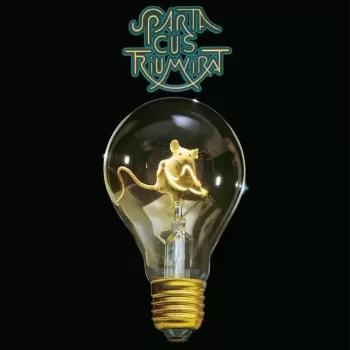
And remarkable it is in a few different ways. The album cover with the mouse trapped in a lightbulb never made any sense, for starters. And we’re still confused by it to this day. What weed the artist smoked exactly to choose an electrical device and animal torture when trying to depict a rendition of a major Roman revolt2 still eludes me to this day. But I must admit, the picture stuck and is still used by many to this day when trying to get to the essence of Triumvirat.
But we’re here for the music, of course. And once The Capital of Power takes you on this journey to a final and thundering defeat, you’re hooked. Spartacus immediately exudes that sense of prog. Actually, our young selves went there only to have The March to the Eternal City3 on equally eternal autoplay. But after a long while of listening to ELP-esque4 beeping and warbling, we finally got to the innards of the piece. And these were studded with pretty outstanding renditions of what today stands for Progressive Rock.
For long stretches, Spartacus feels like a jamming session gone astray. A bit like jazz in a rock session, these guys just let ‘er roll. The outcome is a meandering gaggle of tracks that should have been kept in place by some guardrails. And this turns the instrumental tracks into a difficult listen, to say the least. The same goes with them misplaced interludes into otherwise perfectly fine and balanced tracks. A facet that pulled the rating down a few points straight.
By contrast, the abundant display of tracks with live vocals is a different story. This positively gorges with good to great content. The way The School of Instant Pain artfully takes the theme of the first track and develops it further is straight up to sublime levels. That Triumvirat truly favored keys over guitars is one of the pillars of this record. Toward the second half, the sound turns graver and more dramatic. The Burning Sword of Capula expertly sets the scene for the march on the imperial capital. The only well-balanced instrumental track, by the way. And this leads to the inevitable battle on the aforementioned The March to the Eternal City. The filet piece of the record, lurching forth with a (measured) thunderbolt of dramatic keys and slow-marching melodies.
Ultimately, though, the RMR crew is fully in line with the overall consensus. Spartacus was and still is one of the most outstanding prog pieces of the long-gone year of 1975. A precursor of a style that was to blossom much later. This record remains an inspiration to many a prog band out there searching for their sealegs. Distant voices from the past still en vogue today. You would have thought that.
Record Rating: 7/10 | Label: EMI | Web: Official Band Site
Release Date: 1 July 1975
- The Raven, THE RAVEN, we still hear you.-↩
- It looks like the Roman Empire had a major issue on their hands back then. Check this: https://en.wikipedia.org/wiki/Spartacus.-↩
- I know, the song is called The March to the Eternal City: Dusty Road/Italian Improvisation/First Success. Give me a fucking break, will ya?-↩
- Emerson, Lake, and Palmer.-↩